
Art
[–>
Buffalo
Buffalo AKG Art Museum
‘Convergence’ (1952) by Jackson Pollock
“This is such a distinctly American painting [below]” says 79-year-old artist Stanley Whitney. “At that time American painters were trying to reinvent painting, and no one can reinvent painting better than Pollock.”
New York
The Metropolitan Museum of Art
Toluk (women’s valuable, late 19th-early 20th century) by a Belauan artist, Republic of Palau, Caroline Islands
“This toluk,” says the painter Jordan Casteel, 37, “made by a Belauan artist from polished and carved sea-turtle shells, is essentially money, part of a women-centered system of value used for owning, inheriting and exchange. I love thinking about women’s authority being central here.”
‘The Harvesters’ (1565) by Pieter Bruegel
“My friend James Gibbs recommended I go to the Met just to enjoy this one painting,” says the performance artist Ragnar Kjartansson, 50. “It’s a trick of his. Just walk straight through all the glory, look at this work and go back in time. I stood there in front of the corn and the people taking a rest many hundreds of years ago and dreamed for half an hour. I really, really recommend this method.”
Paintings by Édouard Manet (1832-83)
“It’s absurd to pick one thing, or even five, from the Met’s vast and diverse holdings, but whatever else I’m there for, I always swing by the second-floor European painting galleries to check in with the collection of works by Édouard Manet,” says the painter David Salle, 73. “These paintings are modern consciousness itself — societal, political, sexual, aesthetic, theatrical, presentational — compressed into a brushstroke.”
‘Sleepers’ (1943) by Horace Pippin
“The restrained and intimate nature of [the American painter] Pippin’s work [below] “He takes me into a room with just three or four colors and carefully selected brushstrokes to witness the warmth and care on set,” Casteel says. Makes me want to whisper [so as] Don’t wake them up. ”
Philadelphia
Philadelphia Museum of Art
‘The Large Bathers’ (1900-06) by Paul Cézanne
“If I could have any painting in the world, it would be this one [below]“When I hear it, it reminds me of that record of Bud Powell playing a sick piano in Paris, everything wrong and everything right,” Whitney says. That’s how I feel about this picture. “If loving you is wrong, I don’t want to be right.” ”
London
The National Gallery
‘The Triumphs of Caesar’ (mid-1480s-1506) by Andrea Mantegna
“These are enormous pictures, and overwhelming on every level,” says Salle. “They depict Caesar’s victorious armies returning to Rome laden with every imaginable spoil of war. The drawing, execution, color, control of lighting effects — the pictures are astonishingly present; it’s hard to believe they were painted at the end of the 15th century. And their scathing, unsparing depiction of the world of unfettered conquest, empire and plunder could hardly be more relevant today.”
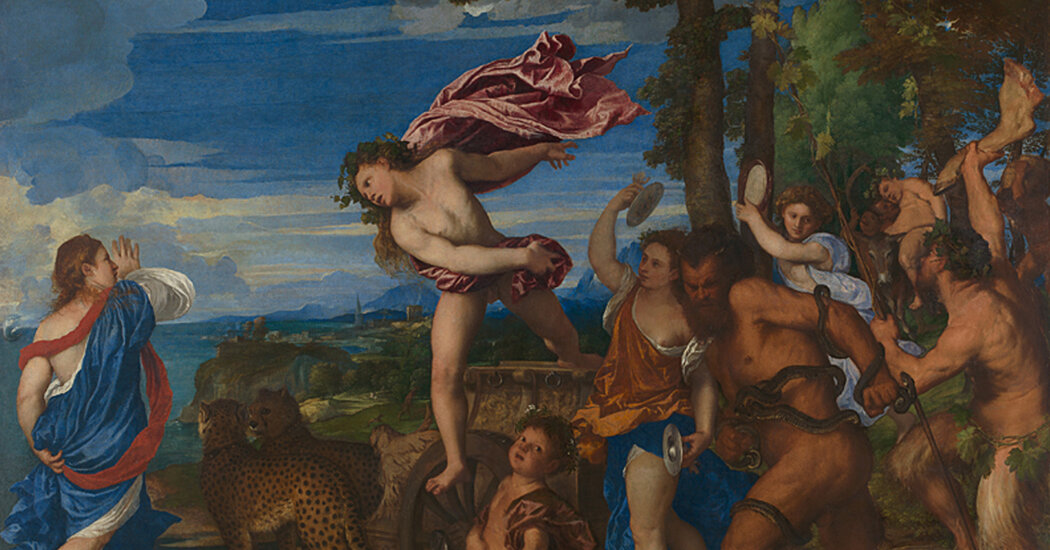
‘Bacchus and Ariadne’ (1520-23) by Titian
“This [below] “This work is very important to me. I wish I had seen it when I was 18. It contains a lot of information about painting: color, movement, structure, etc.,” says Whitney.
London
Tate Modern
‘The Supper’ (1991) by Belkis Ayón
“[The Cuban artist] Ayong’s printmaking is definitely firmly ingrained in my painting DNA,” says painter Toyin Oji Odutola, 40. [below] This work is considered one of her most definitive works and marks the transition from color to black and white. ”
Mexico City
Museo de Arte Moderno de México
‘Canto Triste por Biafra’ (1969) by Gilberto Aceves Navarro
“The three panels at the center form a cacophonous landscape of every conceivable violent mark in muddy black, orange, white and red,” says Ojih Odutola. “They’re sandwiched by two bright, canary yellow sides. Both margins depict the clearest figures in the painting, each holding a gun aimed at the destruction. [The painting (below) is about the Nigerian civil war, which lasted from 1967 to 1970.] I’m not going to tell you what to feel or how long to stay. It was a fulfilling 40 minutes for me. In gratitude for this sad song, I choose to sit as a human being stretching his arms from one continent, one country, one historical conflict to another. ”
Paris
The Louvre
Paintings by Nicolas Poussin (1594-1665)
“It’s some of the most incredible painting — the detail, the storytelling, the narrative within the painting [below]” says interdisciplinary artist Walid Raad, 58. It’s hard to get in because there are so many. [on display] Because it’s like looking at 30 to 40 galaxies. Each one should be explored. ”
Lyon, France
Lugdunum-Musée et Théâtres Romains, France
Roman dodecahedra (first-third century A.D.)
“Archaeologists can’t seem to agree on the purpose of these ancient objects [below]:12 [sides]It has circular holes of different sizes,” says Oji Odutola. The more I wonder about this, the more I want to hold this watch in the palm of my hand, feel its balance, and imagine the impulses of our ancestors who created this watch. ”
São Paulo, Brazil
São Paulo Museum of Art
‘Apparition of the Child Jesus to Saint Anthony of Padua’ (1627-30) by Francisco de Zurbarán
“One of the highlights of Francisco de Zurbarán’s paintings [below] Photographer Wolfgang Tillmans, 57, says, “What appeals to me is the humility of his figures. They have a moving realism and a deep spirituality, and like many of Caravaggio’s works, they sometimes approach a kind of eroticism.” I was impressed by his amazing attention to the weight and texture of the fabric. ”
Amsterdam
Rijksmuseum
‘Syndics of the Drapers’ Guild’ (1662) by Rembrandt van Rijn
“I became aware of this image [below] Rashid Johnson, 48, a painter and conceptual artist, said: “Through the Dutch Masters cigar brand. When I was about 15 years old, I used to buy Dutch Masters cigars and use them to roll blunts. So I was familiar with the image, but I never thought it had any historical significance. When I came across it in the Rijksmuseum, the heights and lows are just fascinating.”
Madrid
The Prado
‘Black Paintings’ (1820-23) by Francisco de Goya
“The room of works by Francisco de Goya is probably my favorite painting room anywhere in the world,” says Johnson. “I’m obsessed with two in particular: ‘Duel With Clubs’ and ‘Saturn Devouring His Son’ [below]. Goya commits a series of sins that reveal something complex and almost difficult to see within his psyche. ”
‘Las Meninas’ (1656) by Diego Velázquez
“ ‘Las Meninas’ is an endlessly renewable miracle,” says Salle. “On one of my visits, another viewer, apparently overwhelmed, fainted, landing in a heap on the floor. I’m surprised it doesn’t happen more often.”
‘The Third of May 1808’ (1814) by Francisco de Goya
“What a great protest painting,” says Whitney. “It has so much humanity. It’s still a powerful statement, and it was painted in 1814.”
Jos, Nigeria
Museum of Traditional Nigerian Architecture
Earthenware buildings (1970s-80s)
“The history of earthenware architecture is plentiful throughout West Africa,” says Ojih Odutola. “As we roamed about these reconstructions of ancient monuments [below]my uncle Ade explained that they are the skyscrapers of our ancestors and still retain their technical ingenuity. If you find yourself in or among these structures, sharpen your senses. Cherish their divinity. ”
Odawara, Japan
Enoura Observatory
‘The Tree of Life’ (2017) by Hiroshi Sugimoto
“On a hillside overlooking Sagami Bay, [the photographer and architect] Enoura weather station designed by Sugimoto [below] “During my visit in 2025, the marble relief of the Tree of Life above the narrow passage leading to the Winter Solstice Light Worship Tunnel had a strong influence,” said conceptual artist Anikka Yi, 54.
Naoshima, Japan
Benesse House Museum
‘One Hundred Live and Die’ (1984) by Bruce Nauman
“This work [below] “Life, death, mediocrity, fear, hope, evil, joy – everything exists separately, and then quite suddenly they all come together, filling the gallery with a shocking explosion of light,” says sculptor Do Ho Soo, 63.
Seoul
National Museum of Korea
‘The Pensive Bodhisattva’ (late sixth-early seventh century)
“These sculptures [below] “They are so beautiful in their quiet clarity. They remind me that life is both very complex and very simple at the same time,” says Sue.
Doha, Qatar
Mathaf: Arab Museum of Modern Art
Paintings by Shakir Hassan Al Said (1925-2004)
“He was an Iraqi artist who was hosted in Doha [Qatar] “It was painted by a member of the royal family during the first Gulf War,” says Mr. Lard. It meant going beyond the surface to a spiritual dimension that was not this retinal. The walls, the texture of the paint, the shadows, everything is the world of painting itself. ”
Florence, Italy
The Uffizi
The paintings of Sandro Botticelli (circa 1445-1510)
“I once went to Florence and visited a nun — a friend of my mother’s,” says Kjartansson. “The nun heard we were going to the Uffizi. She talked of going through all the beautiful paintings of the Virgin and Child. But then she told of the shock of going into the disgusting halls where the corrupt and sinful paintings of Botticelli [below] Go down. This perspective completely changed my view of Botticelli. It made me understand the conditions in which these paintings were created, their strength and atomic sensuality. They had become such cozy clichés about stationery and handkerchiefs that I couldn’t understand them until my sisters opened their eyes. ”
These interviews have been edited and condensed.
More in Art
American Land Art
Is it surreal?
mask
innovation in painting
postwar art
Explanation of concept art
essential pottery
movement of painting
intangible art
What is performance art?
infamous controversy
[0–>See the rest of the issue
#Artists #share #favorite #works #art #Metropolitan #Museum #Art #Louvre #Prado #museums