
Art
[–>
One of the earliest and most famous conceptual artworks is “Fountain” by Marcel Duchamp: a porcelain urinal the artist submitted to an exhibition in 1917. (It didn’t make the cut.) Duchamp believed that “everyday objects [could be] The artist’s chosen actions enhance the dignity of the work of art. ” This philosophy influenced the heyday of conceptual art in the 1960s and early ’70s. At the time, artists such as Lawrence Weiner, Sol LeWitt, and Lee Lozano opposed the commercialization of art by creating works that existed primarily as explanations and ideas. It didn’t really matter whether it took physical form or not. Darren Bader, 48, one of the genre’s main proponents today, whose works include heroin-infused lasagna and butter-soaked Letters to Tom Hanks, has selected five pieces of conceptual art that capture the spirit of what he describes as “the mind is a palace, regardless of its limitations.”
‘3 Standard Stoppages’ (1913-14) by Marcel Duchamp
Duchamp once described “3 Standard Stoppages” — completed three years before “Fountain” — as “a joke about the meter.” Its skepticism of authority and embrace of chance are characteristic of conceptual art: Duchamp dropped three one-meter-long threads onto canvas; each one landed in a different configuration, which he summarily called a new unit of measurement. Then he glued each thread to the surface and cut along the curves, creating three outlandish rulers. “When you see the stoppage forms masquerading as serious art objects, you’re unlikely to get the joke,” Bader says. “I’ve always thought of ‘standard’ as an adjective, but if it’s a metonym for ‘meter,’ a noun, the title’s not so funny anymore.”
‘Grapefruit’ (1964) by Yoko Ono
The Japanese-born, New York-based artist self-published “Grapefruit” two years before she met John Lennon. The book — printed on inexpensive paper and small enough to fit in a handbag — collects instructions-as-artworks that Ono composed between 1953 and 1964. They range from the impossibly whimsical (“Send a smell to the moon”) to the whimsically concrete (“Polish an orange”). “ ‘Life is beautiful’ isn’t such an opulent assumption when seen through Ono’s keen and kind lens,” Bader says.
‘Study for Yvonne Rainer’s “Three Seascapes” ’ (1967) by Sturtevant
Bader describes Elaine Sturtevant — who used only her ex-husband’s last name professionally — as “artist, moniker, cipher, zealot.” The artist spent much of her career reproducing and recreating the work of other (mostly male) artists. Some accused her of copying, though her versions always differed slightly from the originals, but Andy Warhol got it immediately; he even allowed her to borrow the screen he used for his 1964 “Flowers” series, which she used to make her own “Warhol Flowers” later that year. For Bader, the essential Sturtevant work is this little-known version of an avant-garde dance piece by the choreographer Yvonne Rainer in which the performer runs around in a black overcoat to [music by Sergei] Rachmaninoff moves in slow motion undulations and ends with a scream. This performance remains largely legendary to this day.
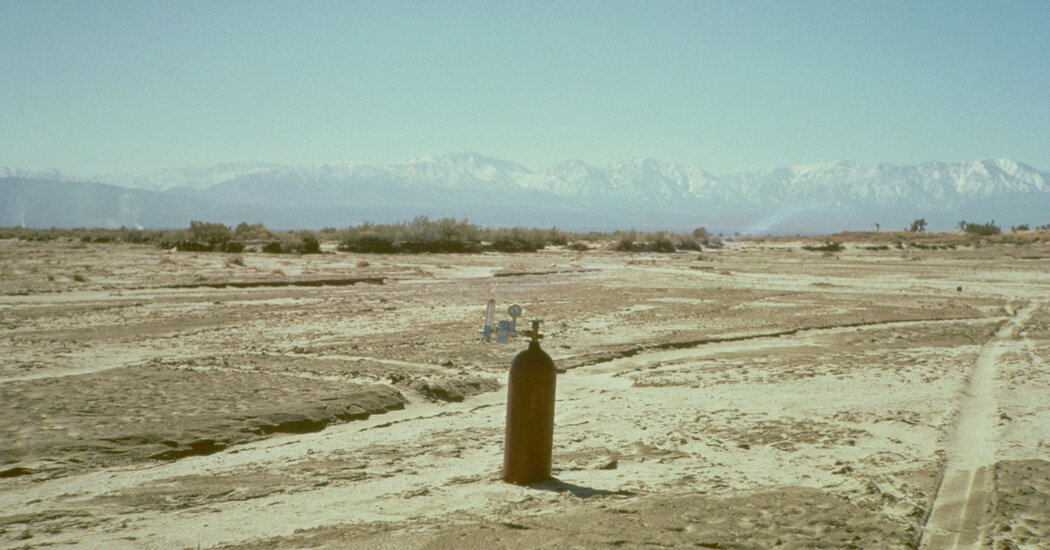
‘Inert Gas Series/Helium, Neon, Argon, Krypton, Xenon/From a Measured Volume to Indefinite Expansion’ (1969) by Robert Barry
In 1969, Barry released five noble gases — helium, neon, argon, krypton and xenon — into the air around Los Angeles. The art dealer and lawyer Seth Siegelaub, who helped execute many important works of conceptual art, published a poster advertising the work without listing a location or date. (The phone number went to a recorded description of Barry’s action.) “Robert Barry’s ‘Inert Gas Series’ has always been my default reference when summoning the quasi-quintessence of the essence I often pine for,” Bader says.
‘One Million Years’ (1999) by On Kawara
The Japanese artist — whom Bader calls a “canonic calendar fetishist” — developed inventive ways to explore the passage of time in his art. The first volume, “Past,” of Kawara’s book “One Million Years” (which actually covers two million years) is a list of the years from 998,031 B.C. to A.D. 1969; the second spans 1993 to 1,001,992. Live readings have been held at museums and galleries around the world, although it would take 100 years to read the whole thing aloud. Bader describes “One Million Years” as “Material tedium meets the breadth of the imagination.”
This interview has been edited and condensed.
More in Art
American Land Art
important museum pieces
Is it surreal?
mask
innovation in painting
postwar art
essential pottery
movement of painting
intangible art
What is performance art?
infamous controversy
[0–>See the rest of the issue
#Conceptual #Art #movement