
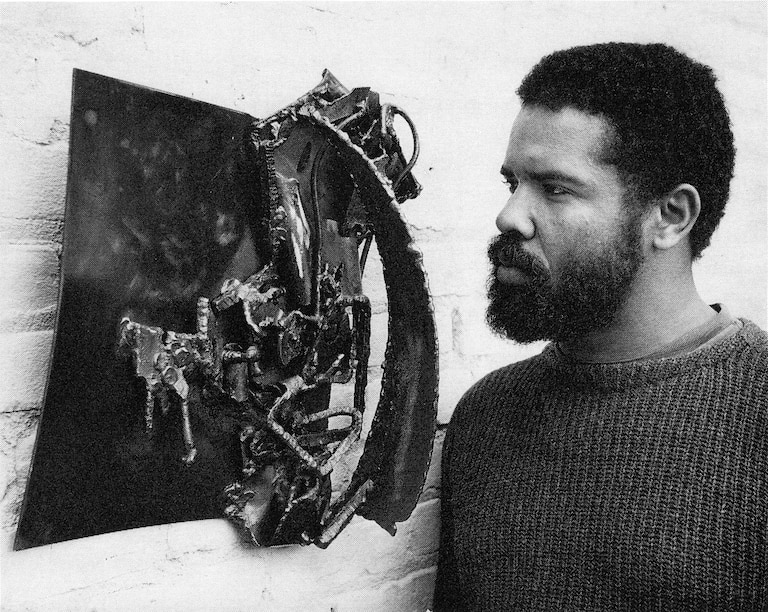
Leslie King-Hammond first met Melvin Edwards when he was a visiting artist at the Maryland Institute College of Art.
The young graduate school director was immediately attracted to him. Although few other artists she knew had spent time studying their craft in Africa, Edwards had apprenticed with a sculptor in Nigeria. His abstract steel sculptures were unusual and fascinating, and the man behind them was unassuming and passionate about his work.
He had already begun to make a name for himself in the art world with his series “Lynch Fragments,” which he began in 1963. The small sculptures, made from recycled steel and fashioned into chains, barbed wire, and other objects, were inspired by black history, the African American experience, and racial violence that he had studied at home and abroad.
King-Hammond said Edwards was a “tremendous force in sculpture” who broke barriers at a time when many black artists were not recognized for their talents. In 1970, he became the first black sculptor to have a solo exhibition at the Whitney Museum of American Art in New York City. Colleagues praised the multilayered messages in his work and the fresh perspective he brought to contemporary American art.
Throughout his career, Edwards exhibited his work in hundreds of cities, including Los Angeles, Chicago, Paris, London, and Baltimore. He was a frequent visitor to MICA in the 1980s and ’90s and had exhibitions at the Baltimore Museum of Art and Morgan State University.
For the last few years of his life, he called Charm City home. Edwards, known for his positive attitude and generosity, died on March 30 at the age of 88.
“He was a man of unparalleled excellence and brilliance, and a philosophically mature person in how he approached the business of creating and making an impact out of metal, wood and mixed media materials,” King-Hammond said.
Edwards was born in Houston on May 4, 1937, and moved to Los Angeles in 1955. According to a biography by Alexander Gray Associates, a leading gallery, Edwards studied painting at the University of Southern California, where he attended on a football scholarship, until he met a graduate student with a welding torch.
“Steel, with its implicit power and physical memory, became the medium of his life,” the biography states.
Edwards was interested in objects with multiple meanings, many of which he incorporated into his body of work. Chains can evoke images of slavery and bondage, but they can also be associated with labor and interpersonal relationships. Barbed wire can symbolize not only agriculture and security, but also oppression and violence.
He utilized everyday tools such as hammers and horseshoes in his carvings. Most of his works, especially those included in the “Lynch Fragments” series, were not literal. Very few were created to depict or imitate real objects or people.
He moved to New York City in 1967, exhibited at the Whitney three years later, and began traveling shortly thereafter. His first trip to Africa in 1970 “opened eyes and doors for me,” he said in a 2019 interview at the Baltimore Museum of Art.
“I quickly realized that art is like a language,” he said. “People invent languages all over the world for different reasons, to express themselves culturally, to express themselves scientifically, and all sorts of other ways.”
Lowry Stokes Sims, a Baltimore-based art historian and curator, said he spoke of an “ancestral relationship” he felt with West African ironworkers. He often talked about his travels.
His work “really opened my mind in terms of how to take forms out of their normal context and reassemble them in an abstract and very evocative way. It doesn’t really imprint a message in your mind, but it allows you to bring your own experience to those forms,” Stokes-Sims said.
At the same time, Edwards shared the concerns of many Black creators that Black creators are devalued and stereotyped to only make a certain type of art.
In 1971, Edwards withdrew from an exhibition organized by the Whitney Museum of American Art for contemporary black artists. He signed a letter calling the exhibition a “waste of time, energy, and life” and “denies consistent appreciation and analysis of the creative content, context, impact, and public value of the work of African American artists.”


King-Hammond said Edwards was a “staple” at MICA throughout the 1980s. He connected with students and freely shared his knowledge and experiences, she said.
“In Mel’s case, he was a great person who could mentor them, give them wisdom, provide guidance, provide infrastructure to help them solve specific problems they were having,” she said.
He was able to adapt his instruction to fit the moment, such as speaking to students through technical questions or leading discussions about sculpture from an African perspective.
His work has been on display throughout Baltimore over the past few decades. In 2024, his sculptures were featured in a group exhibition at the James E. Lewis Museum of Art at Morgan State University.
In 2019, he participated in the exhibition “Generations: A History of Black Abstract Art” at the Baltimore Museum of Art, as well as his own exhibition of “Melvin Edwards: Crossroads,” a collection that represents the cross-cultural connections he has made throughout his career.


He moved to Baltimore in 2017 to live with his surviving wife, Diarra Touré. Until then, I spent most of my time between the New York area and Senegal. King Hammond, who is now in the same city as him, spent nights listening to jazz at Keystone Corner.
“Mel should be remembered for the brilliance of his work, the brilliance of his humanity, and the brilliance of the message in every work he gave to contemporary American art,” King-Hammond said.
“He was a man of great accomplishment who never wavered or hesitated to support those who needed to know or wanted to be a part of knowing and understanding the history of how sculpture plays such an important role in our lives.”
The banner will feature news stories about people who have recently died in Maryland. If a loved one has passed away and you would like to receive information about the death, please contact us below. obituary@thebanner.com. If you are interested in issuing a paid death notice, please contact us. groupsales@thebanner.com Or visit here Website.
#Artist #blends #black #history #steel #sculptures