
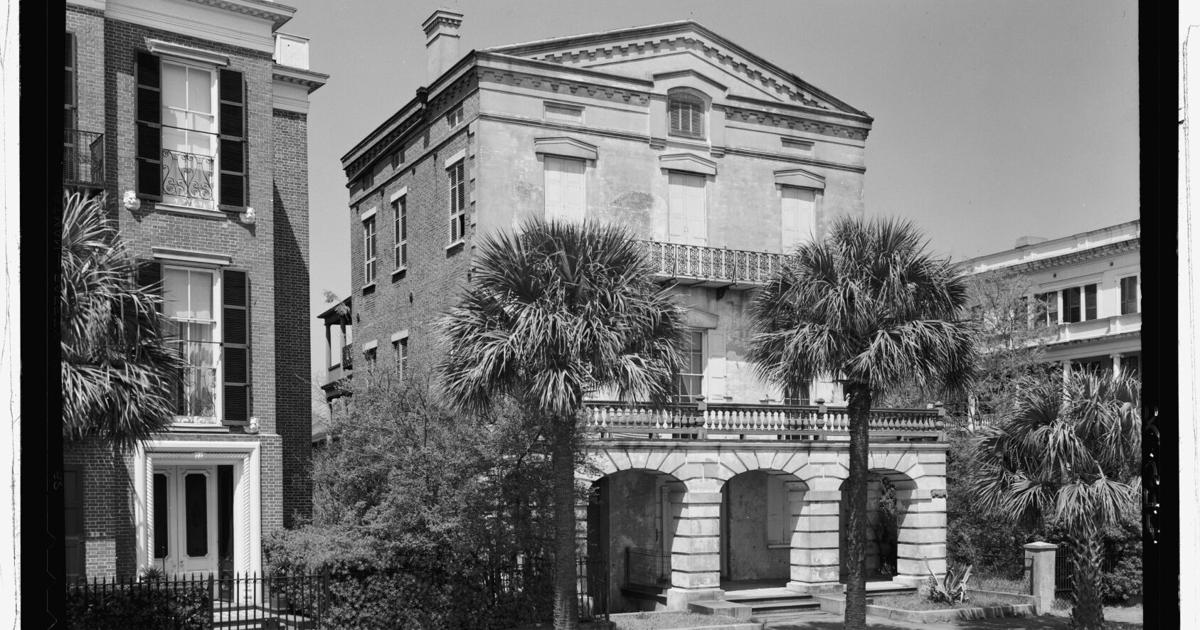
Even an architecture novice casually strolling along Charleston’s scenic High Battery could sense that something was off about the grand mansion at 13 East Battery Street, but few could pinpoint the problem. That’s about to change as Charleston regains a piece of its architectural history that was lost for 140 years.
In the early 19th century, Charleston’s southeast seawall was completed, and subsequent land reclamation created East Battery, a new street with residential neighborhoods just south of the city’s colonial ruins. Some of the Lowcountry’s most prominent families built grand townhouses here with expansive views of Charleston Harbor. Among them were brothers John and William Ravenel, successful merchants in the new steamboat industry.
The pink stucco house at 5 East Battery Street in downtown Charleston was built in 1848 and owned by John Ravenel.
John’s recently restored home at 5 East Battery was sold last year by investor and U.S. Treasury Secretary Scott Bessent for $21.25 million (furnished), at the time the highest sale price ever for a home south of Broad.

William Ravenel House, 13 East Battery St., Charleston
His younger brother, William, began working at Ravenel & Stevens at the age of 16 and eventually became a partner. With the wealth he gained from his business success, William completed a town house at 13 East Battery by 1845. In addition to the St. Andrews Parish plantation, William and his wife Eliza Butler Pringle Ravenel raised 11 children here. This certainly provides at least one justification for the need for a larger home.
Ravenel designed an approximately 15,000-square-foot apartment complex on a deep, narrow lot measuring just over half an acre. The original outbuildings remain, including the kitchen house and two carriage houses. In her book Charleston Residences, published in 1917, author Alice Ravenel Huger Smith describes the first floor of the house as having a long entrance hall, a large dining room, and a narrow side room with folding doors that opened to create a large entertaining space.
Spanning the entire 36-foot width of the house, the second-floor Piano Nobile (Italian for the main floor of a villa, located above street noises and unpleasant smells, with high ceilings and beautiful views), remains one of the largest residential rooms in the historic center.
However, the visual highlight of the Ravenel home was the Greek Revival style portico with an arched base flush with the first floor. Above it, four massive Corinthian columns of brownstone with ornate wind tower capitals rise two more stories to support the pedimented roof. From the portico, Ravenel looked out over the high battery and watched the ships in the harbor.
At 9:51 p.m. on August 31, 1886, less than two minutes later, one of the largest earthquakes ever recorded occurred east of the Mississippi River, knocking all four of Ravenel’s iconic columns into the street. Its echoes are thought to be around 7.2 on today’s Richter scale, and only the base of the portico and a destroyed gable hanging down remain. Given the poverty and destruction in the decades after the Civil War, the columns were never replaced.

The William Ravenel House, located at 13 East Battery Street in Charleston, was damaged in the 1886 earthquake.
In 1959, Hurricane Gracie uprooted a large tree in the garden and, to everyone’s surprise, exposed one of the capitals that had been buried beneath it for decades, driven deep into the earth by the force of the falling pillar.
William Ravenel died two years after the earthquake, but his family continued to live in the house for nearly a century until it was sold in the 1930s, by which time it, like many other properties downtown, had fallen into disrepair.
It was purchased in 1965 by William and Edith Colley, who repaired and restored much of the property before placing it in a trust.
After Edith Colley died in 2013 at the age of 97, her niece and her husband, the sole custodians of the estate, lived there. According to a Post and Courier article by Warren Wise (November 3, 2023), they continued their aunt’s restoration efforts, including using historically correct materials, repairing the stucco, and installing a new roof and air conditioning system.

William Ravenel House
According to a 2023 real estate listing, the complex had 15 bedrooms, 11 bathrooms and two half-bathrooms, divided into several separate residences. Since it was sold in October of the same year, the owners have continued to restore and rebuild it as a single-family home.
But most visible is the recreation of the mansion’s grand columns and pediment, which have been missing since 1886. Once the scaffolding and protective screens begin to be removed, the William Ravenel House will once again boast one of Charleston’s finest, solid, well-proportioned facades.
#Iconic #piece #Charleston #history #missing