
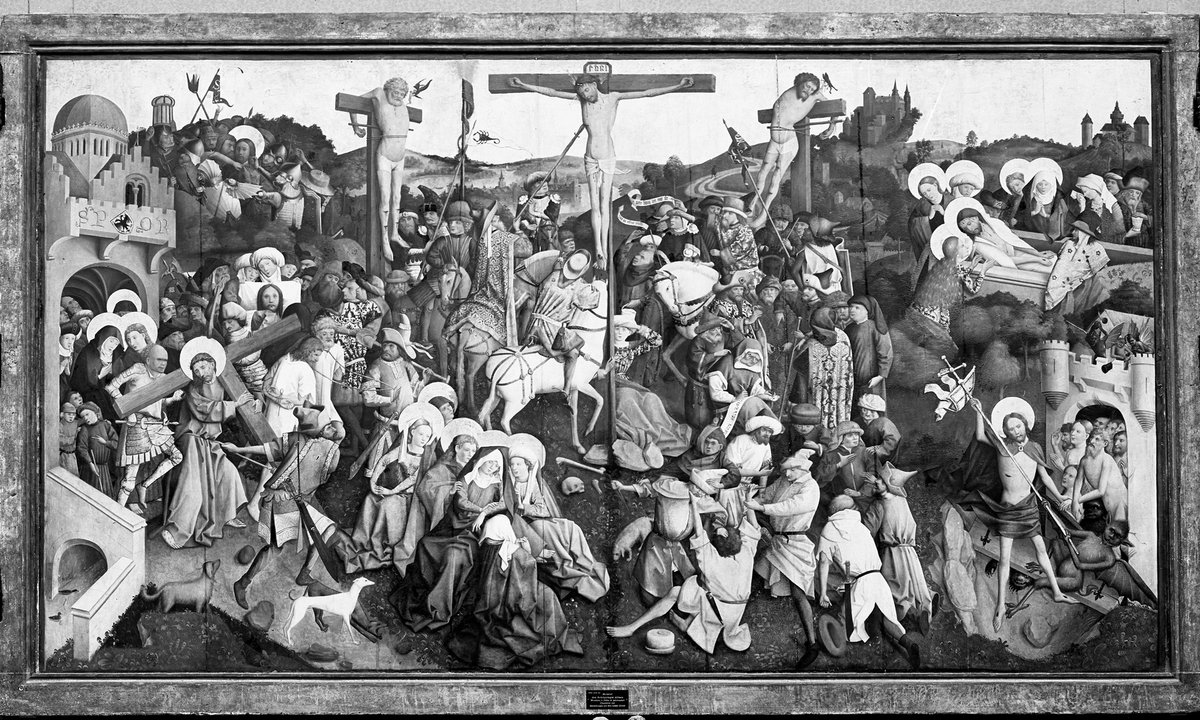
Works by Caravaggio and Peter Paul Rubens lost in a fire during World War II will soon be available for viewing online. Berlin’s art museum, home to Europe’s most comprehensive collection of Old Master paintings, has completed the digitization of its high-resolution glass negative archive of hundreds of destroyed paintings, giving scholars and the public access to one of the most significant museum losses of our time.
In May 1945, at the end of World War II, the Friedrichshain anti-aircraft turret, where approximately 430 large-format works from the museum’s collection were kept for protection, was destroyed by fire twice. It included paintings by some of Europe’s most famous artists, including 10 by Rubens, five by Paolo Veronese, five by Anthony van Dyck, and three by Caravaggio. This loss has long represented a major gap in visual documentation, attribution, provenance, and conservation research. Extant photographs are from an organized campaign that began in 1925. Most of the negatives were created by photographer Gustav Schwarz (1871-1958), who began working at the Berlin Museum in 1906. Katja Kleinert, the museum’s deputy director and project leader, said the works were usually photographed soon after they were acquired. The series continued until 1944 and included wartime acquisitions.
Glass negatives were originally created to comprehensively document collections and to create photographic reproductions for publications and postcards. The plates, organized by format and catalog number, remained for decades in the archives of the Kaiser-Friedrich Museum on Museum Island. When the city’s once-divided collections were united in 1998, they were moved to the Cultural Forum at Potsdamer Platz.
Kleinert explains that, with a few exceptions, the glass negatives have been preserved in very good condition and their clarity is astonishing.
“They have tremendous archival value, not only for the museum and collection itself, but also for the public,” she says. “By digitizing glass negatives, we can understand the significance of our collections in a whole new way.”
new digital life
Kleinert says this accessibility is also important for provenance research, as glass negative collections are essentially the primary visual source for many of these lost works. “People regularly send us images of paintings and ask us if they correspond to works that they believe were destroyed or lost during the war,” she says.
Digitization was carried out in the museum’s photo archive room to avoid transporting the highly sensitive plates. Rather than scanning, the team rephotographed each negative using a high-resolution camera. The images were then edited, cropped, and prepared for upload.
There were also some color photographs within the collection of black and white images, but these were not digitized as part of this project as the process is more complex.
Provenance researcher Franziska May said each negative was placed in a paper envelope with the catalog number, title and artist’s name written on it. During the digitization project, the negatives were unpacked and re-stored on acid-free paper and archival boxes to ensure better long-term protection.
“It’s amazing that the collection has survived so well, given its fragility,” she says. “Only a small number of plates were damaged.” The digitization itself took just under six weeks. Editing, database preparation, and online publication took several months.
When these images are published in the museum’s online collection database, likely later this year, the works, previously accessible primarily through the printed Ross catalog with small illustrations, will be available for viewing in high resolution to a global audience. Users can zoom in and enlarge the image, and it is also available for download, although the downloadable version is not at full maximum resolution.
Kleinert said the museum also plans to digitize glass negatives for other losses recorded in the catalog, including old loans that were never returned, paintings confiscated by Soviet forces and not repatriated, and works that were recorded as stolen or destroyed before 1945, bringing the total to about 585 items.
“When it’s digitized, there’s a certain sense of security because it’s stored digitally,” Kleinert says. “When you hold a glass negative in your hand, you realize how fragile it is. You don’t want to drop it.”
#Works #Caravaggio #Rubens #destroyed #fire #World #War #revived #digitally