
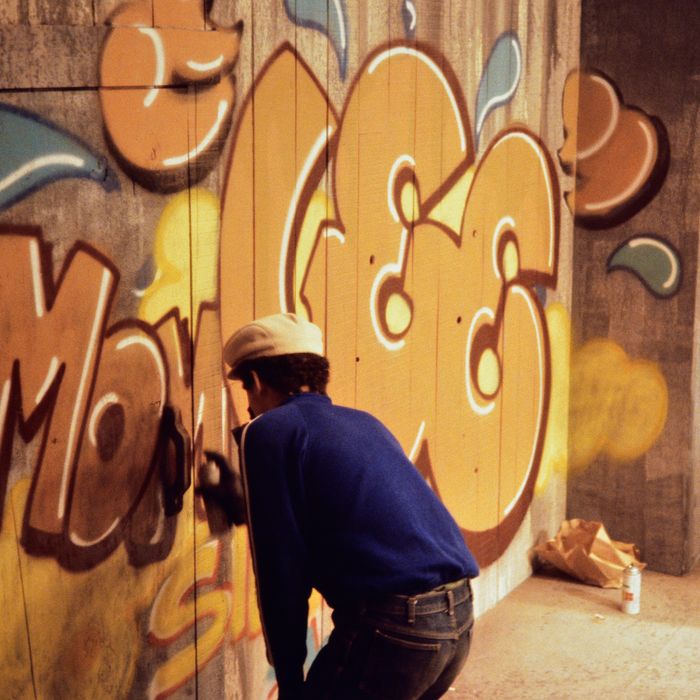
Quiñones on the set of the “Rapture” music video.
Photo: Charlie Ahearn
In 1980, Lee Quiñones was 20 years old and already a household name to subway riders. On the 4, 5, J, M, and R trains, LEE was graffitied across the carriages in giant blocks of text, the letters sometimes cracked or crumbling and molded into barely recognizable shapes. Quiñones often drew inspiration from comics and comic books, drawing dragons and most famously Howard the Duck. He and his art collective, the Fabulous Five, used graffiti as a kind of dialogue with the city, some of whom believed their work was, in the words of Mayor Ed Koch, “subverting our lifestyle.” What is graffiti art? They wrote on one car. Look at yourself.
City leadership did not respond kindly. When asked in 1980 how the city would police graffiti artists, Koch said, “If I had my way, I would put in wolves instead of dogs.” A year later, his administration actually built a tall barbed wire fence and placed German shepherds around a train depot in Queens. The MTA then began an experimental program called the “Great White Fleet,” painting approximately 12 7-car trains completely white. This was apparently in the hope of deterring vandalism. “Can you believe it?” Quiñones said. “They actually created a canvas.” (This program was immediately discontinued.)
my lost art world
See all
Quiñones knew he would eventually have to move away from subway art, and throughout the early ’80s he steadily brought more work above ground. He painted murals on the walls of handball courts in lower Manhattan, experimenting with shading and depth of field. “People used to make pilgrimages to that wall,” he recalls. “I don’t even know how that happened.” One of them was graffiti artist Fab 5 Freddy, who went on to become something of a downtown godfather and a mainstay of the ’90s hip-hop scene. He sought out Quiñones as he sat in a classroom, still trying to get his GED after dropping out of high school. “He came in and very formally said, ‘I want to talk to that gentleman,'” Quiñones says. “I thought he was a cop.”
Fab Five Freddy (confusingly not one of the original members of the Fabulous Five) became one of Quiñones’ biggest collaborators. Quiñones says it was at parties and art shows, mostly held in “abandoned institutions,” that he met a variety of mythologized artists who went on to define the era, including Debbie Harry, Keith Haring and Jean-Michel Basquiat. Their aesthetic as a group is largely defined by Graffiti’s flashy, unabashed visual style, so much so that Blondie commissioned Quiñones, Fab 5 Freddy, and Basquiat to create two music video sets, with Quiñones exploding paint on the walls and Basquiat scrawling words on the edges.
Leading gallerists and curators soon became interested in this irresistibly cool little underground world. One of the first major shows to spotlight graffiti art, “New York/New Wave” at MoMA PS1 drew crowds from all corners of the scene. Shortly after, Barbara Gladstone asked Quiñones to represent her and entered the pet store where she was working arm-in-arm with gallery director Alan Schwartzman. In the late ’80s, Quiñones’ world suddenly seemed to collapse, when the art market collapsed and the AIDS epidemic hit downtown. He put much of that into his work, creating murals such as: golden child As a tribute to his friend Hering.
Today, he primarily paints on canvas, but continued to create murals into the early 2010s. In one, requiem, He painted a life-size medevac helicopter emerging from a vibrant, coiled jungle on the side of a Lower East Side building. “People still ask me, ‘Lee, how did you do that?'” he says. “And the answer is always ‘subway.’ They taught me three things: how to work with little to no light; composition, knowing how to work with every aspect of the car; and timing — To come and go by a fixed time.” — Paula Aceves
#wanted #graffiti #artist #York